
 See My Latest Article on HelloNation
Bodyweight exercises can build noticeable muscle when the training is challenging, consistent, and progressively harder over time. Push-ups, pull-ups, squats, lunges, dips, and core movements can provide effective resistance without a full gym, although advanced muscle growth may eventually require added weight or more difficult variations.
Can bodyweight exercises build muscle?
Yes. Muscle growth occurs when muscles are exposed to enough resistance and fatigue, followed by adequate recovery and nutrition. Bodyweight training supplies resistance through leverage, body position, range of motion, and movement difficulty.
A beginner may gain strength and muscle from standard push-ups or bodyweight squats. As the body adapts, those same exercises may become too easy. Progress can then come from:
- Increasing repetitions
- Adding sets
- Slowing the lowering phase
- Pausing at the hardest point
- Using a longer range of motion
- Choosing a more demanding variation
- Reducing rest periods carefully
- Adding external resistance when appropriate
The goal is not simply to perform hundreds of repetitions. A set should become challenging enough that the final few controlled repetitions require substantial effort while maintaining sound technique.
Which bodyweight exercises are most effective for muscle growth?
A productive routine should train pushing, pulling, squatting, hinging, single-leg movement, and core stability. These movement categories cover most major muscle groups.
Push-ups and their progressions
Push-ups train the chest, shoulders, triceps, and muscles that stabilize the torso. Keep the body in a straight line, brace the abdomen, and lower the chest with control.
Useful progressions include:
- Incline push-ups for beginners
- Standard push-ups
- Pause push-ups
- Decline push-ups
- Close-grip push-ups
- Archer push-ups
- One-arm push-up progressions
A slower three-second lowering phase can make a standard push-up substantially harder without changing the number of repetitions.
Pull-ups and inverted rows
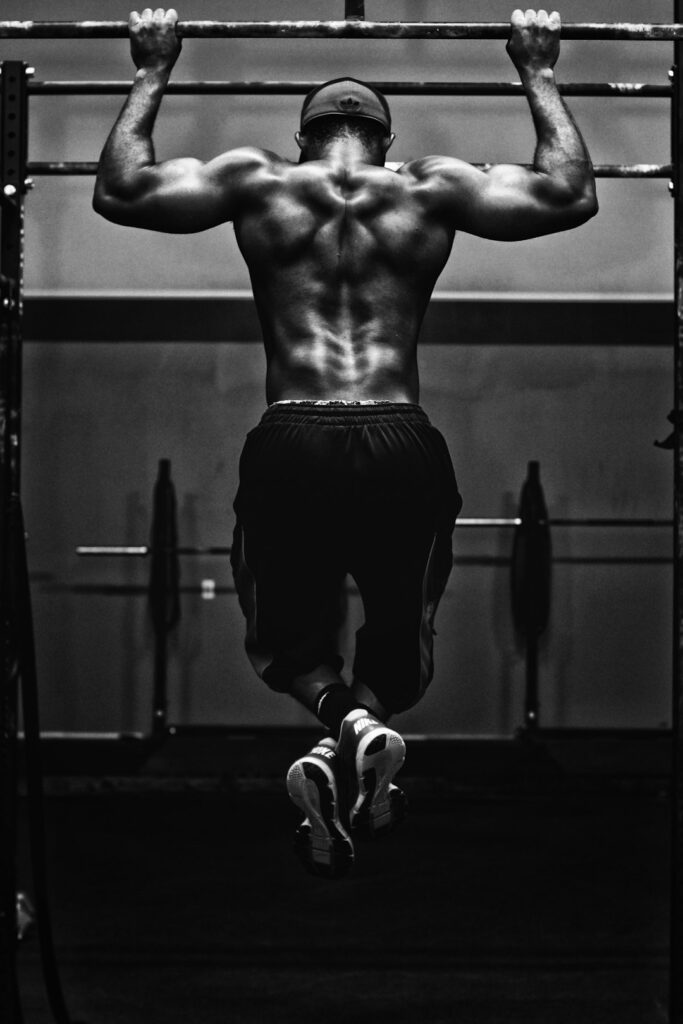
Pulling movements develop the back, biceps, forearms, and shoulder stabilizers. Pull-ups are highly effective, but they require a secure bar and enough initial strength to control the body.
Progress from dead hangs to scapular pull-ups, assisted pull-ups, and negative repetitions. Inverted rows are another useful option when a sturdy horizontal support is available. The body should remain firm while the chest moves toward the support.
Never use an improvised structure that may shift, break, or detach. Exercise equipment must be designed to support dynamic body weight.
Squats and split squats
Bodyweight squats train the quadriceps, glutes, and supporting muscles around the hips and knees. Descend as far as comfortable while keeping the feet stable and the knees tracking generally in line with the toes.
For more muscle-building difficulty, use:
- Tempo squats
- Pause squats
- Bulgarian split squats
- Reverse lunges
- Walking lunges
- Shrimp squat progressions
Single-leg exercises are particularly useful because they increase the demand on each leg without requiring heavy equipment. They also reveal balance and mobility differences between sides.
Glute bridges and single-leg bridges
Glute bridges train the glutes and contribute to hip stability. Press through the feet, keep the ribs from flaring upward, and pause at the top without forcing the lower back into excessive arching.
A single-leg bridge increases the challenge. Sliding-leg curls using towels on a smooth floor can also train the hamstrings, but the movement should be performed slowly to avoid sudden loss of control.
Dips, pike push-ups, and handstand progressions
Dips emphasize the chest and triceps, while pike push-ups place more demand on the shoulders. Handstand push-up progressions can be effective but require careful attention to wrist, shoulder, and neck positioning.
Dips should only be performed on stable equipment with enough room for safe movement. Deep dipping can irritate the front of the shoulder for some people, particularly if control is lost at the bottom.
Planks, hanging knee raises, and hollow-body holds
Core exercises support movement quality but should not replace full-body resistance training. Planks train bracing endurance, while hanging knee raises involve the abdominal muscles and hip flexors. Hollow-body holds develop trunk control useful for push-ups, pull-ups, and other movements.
Quality matters more than duration. A shorter hold with a firm, controlled position is generally more useful than a long hold performed with the lower back sagging.

How should a bodyweight routine be organized?
Most people can begin with three full-body sessions per week, leaving at least one day between demanding sessions. A simple workout might include:
- Push-ups: 3 sets of 6–15 repetitions
- Inverted rows or pull-up progressions: 3 sets of 5–12 repetitions
- Split squats: 3 sets of 8–15 repetitions per leg
- Glute bridges: 3 sets of 10–20 repetitions
- Pike push-ups: 2–3 sets of 6–12 repetitions
- Planks: 2–3 controlled sets
These ranges are starting points rather than fixed rules. Stop a set when technique begins to break down. Rest for roughly one to three minutes between challenging sets, using longer rests for demanding movements such as pull-ups or single-leg squats.
Residents with limited indoor space can use a small clear area, a stable wall, and a sturdy exercise mat. In Miami, heat and humidity can make outdoor training feel harder than expected, especially during warmer parts of the day. Hydration, shade, ventilation, and sensible timing help reduce unnecessary fatigue. Sweat loss is not a measure of muscle-building success.
How does progressive overload work without weights?
Progressive overload means gradually increasing the training demand. With bodyweight movements, this can be done without immediately buying equipment.
For example, a person might progress from:
1. Three sets of eight standard push-ups
2. Three sets of twelve standard push-ups
3. Three sets of eight pause push-ups
4. Three sets of eight decline push-ups
Another approach is to increase the range of motion, use a one-sided variation, or add a controlled pause. Keeping a basic training log makes progress easier to identify.
If a person can consistently perform more than about 20 controlled repetitions with little fatigue, the exercise may be better suited to endurance than muscle growth. A harder variation or modest external load can make the work more productive.
What helps bodyweight muscle growth besides exercise?
Muscle development depends on recovery as well as training. Regular sleep, sufficient calories, and adequate protein support adaptation. Protein-rich foods may include eggs, dairy products, fish, poultry, beans, lentils, tofu, and other options that fit personal dietary needs.
Frequent soreness is not required for growth. Mild soreness can occur after unfamiliar training, but persistent joint pain, sharp pain, numbness, dizziness, or unusual shortness of breath is a reason to stop the session and seek appropriate medical guidance.
Warm up with several minutes of easy movement followed by practice repetitions of the first exercises. A warm-up should prepare the joints and nervous system, not exhaust the muscles before the main work begins.
Common mistakes that limit results
The most common problem is repeating the same easy routine for months. Bodyweight training works best when the challenge changes as strength improves.
Other frequent mistakes include:
- Using fast, uncontrolled repetitions
- Training the same muscles hard every day
- Neglecting pulling exercises
- Treating poor sleep as irrelevant
- Mistaking sweat for progress
- Ignoring pain around the shoulders, knees, wrists, or lower back
- Advancing to difficult variations before mastering basic form
A balanced routine, gradual progression, and consistent recovery usually produce better results than constantly changing exercises. Bodyweight training can remain effective for a long time, particularly when leverage, tempo, range of motion, and single-limb variations are used deliberately.